Updated October 2026. This article now reflects FDA's April 2026 change and the July 2026 advisory committee vote. Compounding Finder does not currently route BPC-157 quote requests.
What Is BPC-157?
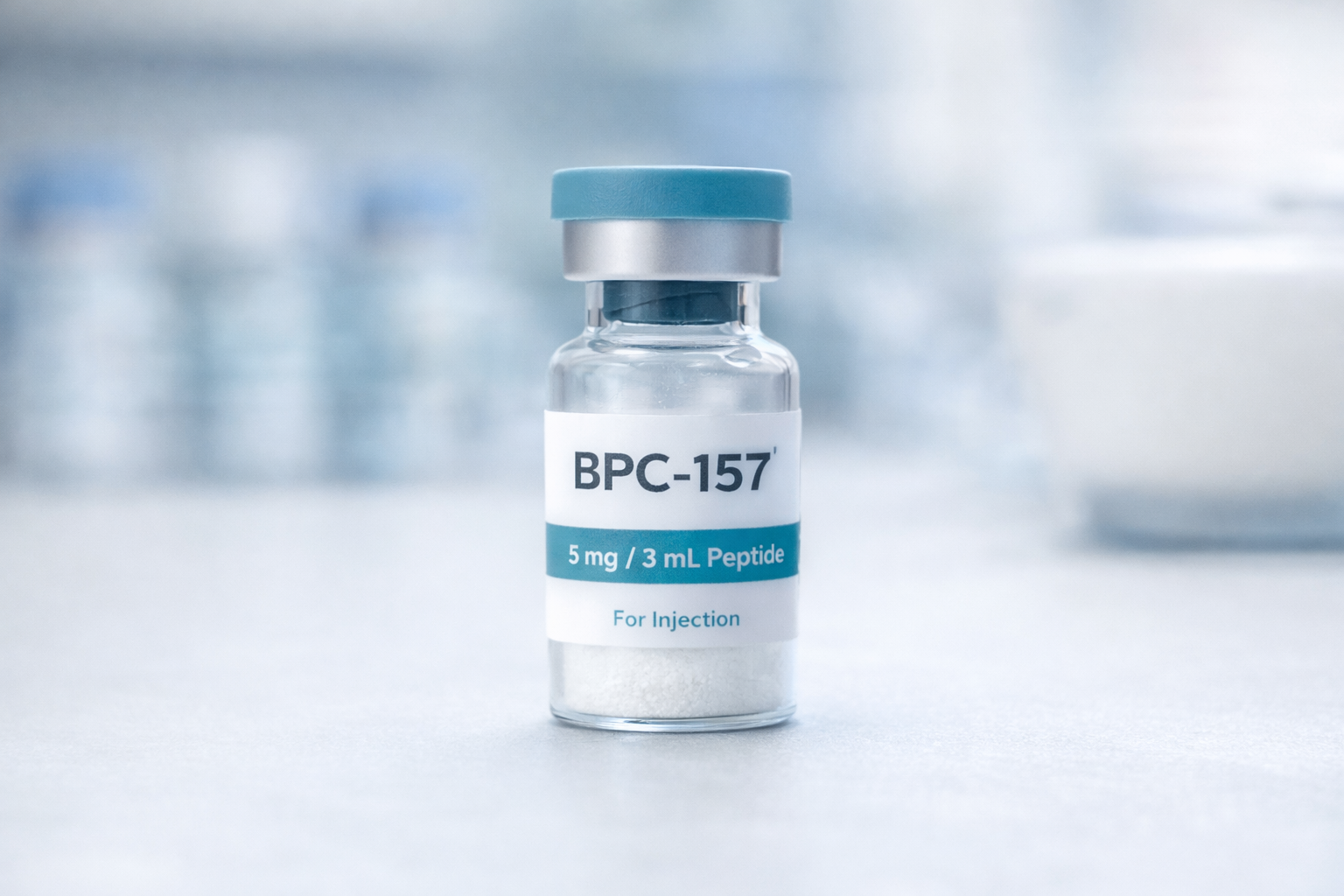
BPC-157 (Body Protection Compound-157) is a synthetic peptide derived from a protein found in human gastric juice. It consists of 15 amino acids and has been studied extensively in animal models for its regenerative and protective properties across multiple tissue types. It has not received FDA approval for any indication, but it has become one of the most widely discussed peptides in sports medicine, integrative health, and gastroenterology circles.
No drug company makes an FDA-approved version of BPC-157. It is also not on FDA's list of bulk substances that compounding pharmacies may use, so US compounding pharmacies currently have no clear legal pathway to prepare it. The legal status section below explains why.
What Is BPC-157 Used For?
The primary areas of interest for BPC-157 include tendon, ligament, and muscle repair, making it popular among athletes and people recovering from orthopedic injuries. It's also studied for gut healing — particularly for conditions like inflammatory bowel disease, leaky gut, and gastroparesis — due to its apparent effects on gut wall integrity and motility.
Additional areas of use reported by patients and practitioners include nerve regeneration, wound healing, bone healing, and systemic anti-inflammatory effects. Some research suggests it may influence dopamine and serotonin pathways, though this area is less developed.
What Does the Research Show?
The honest answer is that most BPC-157 research is in animals — primarily rats and mice. The results in rodent models have been consistently impressive across injury types, which is part of why interest in the peptide has grown so rapidly. However, robust human clinical trials are largely absent. The gap between animal and human evidence is a legitimate limitation that practitioners and patients should weigh carefully.
Part of the gap is economic: synthetic peptides are hard to patent, so drug companies have little incentive to fund large trials. Supporters point to plausible mechanisms and few reported side effects. FDA has been more cautious. It has said it found little or no safety information for the proposed routes of use, and that BPC-157 may carry a risk of immune reactions by some routes and may raise problems with peptide-related impurities.
Forms
BPC-157 has mainly been used in two forms. Injectable BPC-157 is given subcutaneously, often near the site of an injury for musculoskeletal goals, and is thought to reach the bloodstream more reliably. Oral capsules are more often used for gut-related goals and are easier to take.
Is BPC-157 Legal?
BPC-157 is not FDA-approved and is not a DEA-scheduled substance. What matters for compounding is Section 503A of the Federal Food, Drug, and Cosmetic Act: a compounding pharmacy may only compound from a bulk ingredient that is part of an FDA-approved drug, has a USP or NF monograph, or is on FDA's 503A bulk drug substances list. BPC-157 meets none of these.
- Late 2023: FDA placed BPC-157 in Category 2, its list of bulk substances that may present significant safety risks.
- April 2026: FDA took BPC-157 off the Category 2 list; it now appears among nominations that were withdrawn. That did not add it to the 503A list, and BPC-157 is not in Category 1, the substances FDA does not object to pharmacies using while it evaluates them.
- July 23, 2026: FDA's Pharmacy Compounding Advisory Committee voted 8–6, with one abstention, to recommend adding BPC-157 to the 503A list. FDA's own reviewers had recommended against it.
The committee only advises FDA. Adding a substance to the list takes FDA rulemaking, and as of October 2026 FDA has not proposed it. Until it does, US compounding pharmacies have no clear legal pathway to prepare BPC-157, with or without a prescription. Some still offer it; they are relying on their own reading of the rules.
BPC-157 is also prohibited in sport by the World Anti-Doping Agency (WADA).
Can I Get BPC-157 Through Compounding Finder?
Not at this time. Because BPC-157 is not on the 503A list, Compounding Finder does not send BPC-157 requests to pharmacies. We will update our BPC-157 legal and safety page if FDA acts.
Be wary of websites selling BPC-157 as a "research peptide" labeled not for human use. They operate outside FDA and state pharmacy oversight, and their products may be underdosed, contaminated, or mislabeled.
Bottom Line
BPC-157 has a compelling preclinical profile for tissue repair and gut healing, but human evidence remains limited and FDA has raised safety questions. It is not on the 503A list, the July 2026 committee vote has not changed that yet, and Compounding Finder does not route BPC-157 requests. If BPC-157 was suggested to you, talk to your prescriber about the condition you want treated and the FDA-approved options for it.
We Do Not Currently Route BPC-157 Quote Requests
BPC-157 is not on the FDA 503A bulk drug substances list. An FDA advisory committee voted in July 2026 to recommend adding it, but FDA has not acted, so US compounding pharmacies have no clear legal pathway to prepare it and Compounding Finder is not sending BPC-157 quote requests to pharmacies. If FDA guidance changes, we will revisit.